My 5-Year-Old Wouldn't Let Me Off the Hook
Blog post #20
My son Edwin is five years old. Every other week he asks me to download a new game. And every time, I say the same thing:
“Why don’t we build one instead?”
He loves the idea. He says yes. And then life happens, and I don’t follow through. A week passes. He reminds me. I say soon. Another week. He reminds me again. This cycle repeated more times than I’d like to admit.
Until one day I actually sat down and did it.
This is the story of the first game we built together — and my first time ever touching a game engine.
The Game: Pixel Beat Em Up
We’re building a retro beat em up inspired by two classics:
- Golden Axe for the gameplay feel — simple, satisfying combat, couch co-op energy, that “one more round” pull
- Warriors of Fate for the visual style — rich, detailed pixel art with that fantasy-epic atmosphere
The engine: Godot 4.6. The budget for assets: zero dollars.
Free Assets Are Surprisingly Good These Days
I was genuinely impressed with what’s available for free. We’re running with:
- Knight from itch.io — a full character with 7 animations: Idle, Run, Attack, Death, Roll, Shield, and JumpAndFall. Legit quality.
- Ninja Adventure Asset Pack from itch.io — enemies (slimes, monsters), dungeon tilesets, backgrounds, even audio
- Kenney Pixel UI — clean HUD elements, health bars, the whole nine yards
Kenney in particular is a name every indie dev seems to know. I’m late to that party but now I understand the hype.
What We Actually Built
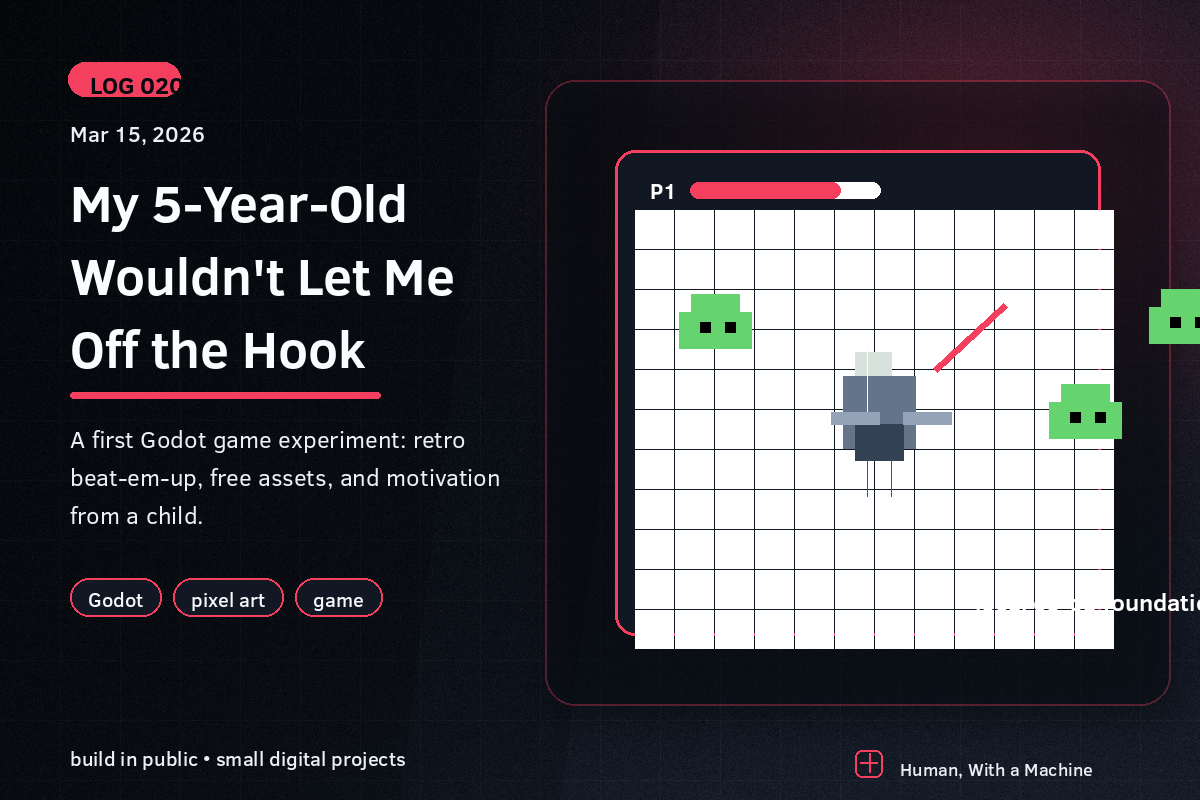
Playable knight character — moves in 8 directions (WASD), attacks with Space, auto-flips the sprite based on movement direction, and is constrained to the playfield boundaries. It just feels like a beat em up.
Enemy AI — slimes patrol the arena and chase the player when they get close. They take damage and die. Nothing fancy, but it’s alive.
HUD — health bar for P1 (and P2 when the second player joins), built with the Kenney assets.
Procedural dungeon background — we tile the dungeon floor and walls from the Ninja Adventure tileset at runtime.
2-player foundation — the input system is already wired for two players. P1 gets WASD + Space, P2 gets Arrow keys + Enter. Because Edwin is going to want to play too.
Stepping Into Godot as a Complete Outsider
Game development is genuinely new for me. Getting into Godot was a learning curve I didn’t fully anticipate. It’s a completely different mental model from building apps or services. Scenes, nodes, signals, physics layers — it’s its own world, and it took some time to feel oriented inside it.
The ideas for this project came partly from Peter Yang and his thinking around what solo builders can realistically ship. Which brings me to something I keep hearing in the one-person company space:
Animations are still something many solopreneurs outsource.
Once you’re inside a game engine, you quickly understand why. High-quality animation is its own craft. The assets we grabbed from itch.io are doing a lot of heavy lifting here. The general sentiment is that AI hasn’t quite leveled up enough to replace this yet — but everyone’s watching that space closely.
For now: free pixel art packs and talented artists on itch.io are the move.
What’s Next
Milestone 2:
- Combo system
- Knockback and proper hitbox collision
- Full 2-player local co-op
Milestone 3:
- Magic / special moves (Golden Axe-style)
- Multiple levels + a boss
- Sound and music
- Game over / win screens + polish
Edwin has already asked twice when he gets to play it properly.
That’s enough motivation to keep going.