Rebuilding a Childhood Math Game: The Cheops Pyramid
Blog post #30
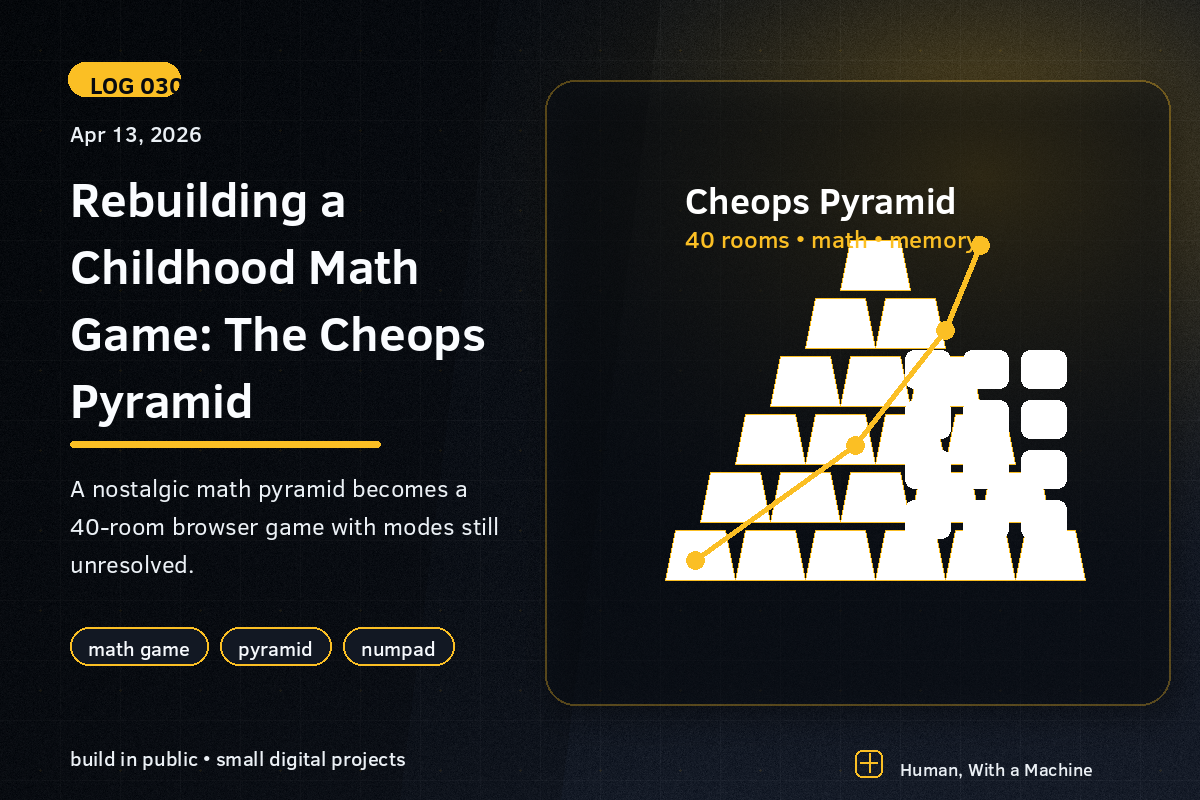
I’ve always loved math. Not in the quiet, dutiful way — in the I want to beat the thing that wasn’t meant for me yet way.
There was a math game I played in elementary school, maybe 5th or 6th grade. It was called the Cheops Pyramid, and it was built for high school students. That detail mattered enormously to us. We knew the gap we were trying to close. When our class finally beat it — with a little help from our teacher, who told us what Acarus was in Latin when we got stuck — the pride was enormous. We weren’t supposed to win. We won anyway.
What I built
Tonight I sat down and rebuilt it. A modern interpretation of the Cheops Pyramid.
It started as a 10-room demo. Then it became 40 rooms. That’s how these things go.
The project pulls in three directions simultaneously, and I haven’t fully resolved the tension between them:
- Faithful to memory — I want it to feel like the original. The progression, the difficulty curve, the sense that you’re climbing something real.
- Modern interpretation — Updated visuals, better UX, runs in a browser. The feel of the numpad on the right side of a keyboard is part of the original experience I want to preserve.
- Accessible to my 8-year-old daughter — A simplified mode that keeps the spirit without the high-school math.
These three versions of the game are in tension. What’s the right difficulty for the main mode? What gets stripped for the kids’ mode? Where does modern polish stop being an improvement and start being a different game?
What I’m proud of
I built a speed mode — a way to run through all the rooms quickly to get a feel for the difficulty curve across the whole game. It’s been invaluable for level design.
The thing I’m most proud of, though, is the level-builder file. It gives a clean overview of the entire 40-room structure: what math concept is in each room, what the difficulty progression looks like, what’s been tested and what hasn’t. It makes it possible to actually talk about level design as a design problem rather than just poking around in code.
What’s still open
The three modes need a decision. Not just implementation — a design decision. What is this game, exactly? A nostalgia project? A kids’ math app? A product?
If it’s a product: App Store, or desktop-focused? The numpad experience is part of the soul of the original. Touch screens don’t have that. A desktop app preserves it. But distribution is a different conversation entirely.
I don’t have an answer yet. But I like where the question has landed.
— Stefan